Showing posts with label book reviews. Show all posts

Sunday, July 19, 2009

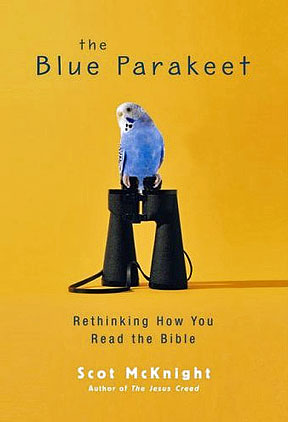
THE BLUE PARAKEET [book review]

Fear not. The subtitle of Scot McKnight's book sheds a little light: "Rethinking How You Read the Bible." I won't tell you why he calls it "The Blue Parakeet." I'll make you go read it.

McKnight begins by telling the story of how he developed a love for the Scriptures. He devoured the study notes in whatever study Bible he had. His youth pastor in high school encouraged him to learn Greek. In college, he would go hang out at Eerdman's, Zondervan, and Baker Publishing. Before long, McKnight said that he came across a question that disturbed him then and does to this day. The question is actually simple on the surface: How are we to apply the Bible today [pg 12]?

The examples of tithing, Sabbath, foot washing, and spiritual gifts are used by McKnight as examples of issues that many Christians disagree on. His point is that we all read the same Bible but come to vastly different conclusions, not merely nuanced and peripheral distinctions.

On pgs 29-35, McKnight suggests that people often read the Bible through tradition or with tradition. He explains these differences. After giving several insufficient ways in which people read the Scriptures, he argues that the Bible should be read as a story. His analysis of man being made in God's image and the purpose of Genesis 1-2 is a beautiful portrayal of how the rest of the Bible should be read as story. Later on, however, I believe he betrays this correct construal of Gen 1-2.

McKnight speaks with clarity about Jesus being the redeeming apex of God's redemptive purposes for His covenant community [pgs 72-79]. His point is that the Bible's authority is not innate. God's authority is innate. The Bible, specifically the person and work of Jesus, is to usher is the relationship that was marred in Gen 3. J. P. Moreland wrote a paper a couple of years ago about how Christians are over-committed to the Bible. He called this disease Bibliolatry ["the worship of the Bible"]. I think the idea that Moreland was trying to get across is the same one that McKnight is hinting at:

Adoring a love letter from your wife over adoring your wife is stupid. The letter itself is not stupid, but it is preposterous to have equal emotions for the ink on that page and for the one who penned it.

So, what is the Bible's purpose? What is its design? McKnight goes on to talk about listening to the Bible. He cites Klyne Snodgrass: "The biggest complaint in Scripture is that people do not listen to God. Theirs is a freely chosen deafness." McKnight then gives several chapters to the "how" of listening to the Scriptures. This is where he returns to the problem of picking and choosing he raised in chapter 1. Here, McKnight raises more fragile issues such as divorce, death penalty, homosexuality, and others.

Finally, McKnight seeks to apply listening, discerning, and tradition to one of the toughest issues in western evangelicalism: women in ministry. I love the way he ends his argument on pgs 145-207. However, I feel as though he betrays some of what he has already said and some occasional textual clarity in his discussion. He ends by telling a story of his family visiting F. F. Bruce in the spring of 1981. He says that he remembers the conversation word for word:
"Professor Bruce, what do you think of women's ordination?"

"I don't think the New Testament talks about ordination."

"What about the silencing passages of Paul on women?"

"I think Paul would roll over in his grave if he knew we were turning his letters into torah."

"What do you think, then, about women in church ministries?"

"I'm for whatever God's Spirit grants women gifts to do."
The kind of honesty seen in Professor Bruce is the kind of honesty that McKnight presents in his Blue Parakeet and most of this honesty is biblically warranted. He asks questions that many conservative evangelicals are scared to ask. He asks questions that are clearly there in the text, but it is often too taboo to ask them because the weight of tradition says we shouldn't.

Do I agree with all conclusions? Not really. Do I thank God for his sincerity and scholarship? You bet. Do we both openly admit that we want to be led by the Spirit of God, the word of God, and the community of faith? Yes indeed.

Lastly, McKnight's appendices at the end of the book might just be worth the price of the book. One of them is a test he gives his students every year. The test includes a section of questions about Jesus and a section about the person taking the test. Without fail, the test proves that we often make Jesus out to be like us.

So, if you care at all about the "how" of Bible reading, go snag the Blue Parakeet. You can read it in two days. I promise you'll be challenged.

Monday, April 27, 2009

Justification

At the conference, I was also able to pick up Tom Wright's new book on justification. It will not officially come out in the states until the summer.

His interactions with Piper are direct. He sees the big picture. I love his emphasis on the Spirit, the covenant, and eschatology in justification.


Wright also has several chapters of introductory material that are very rich for any Bible reader. I am personally challenged at the length these guys go to in order to be faithful to the Scriptures.

Wednesday, March 25, 2009

THE TRAiL OF BLOOD

Baptists are not Protestants.

This is the premise of the short little booklet, "The Trail of Blood" [J. M. Carroll]. It was first published in 1931 and has still strangely remained.

He argues, with ample historical and biblical ammunition, that the majority of the groups that were persecuted and often condemned through church history were baptistic in nature [the Montanists, Paulicans, and many others].


Cardinal Hosius was the president of the Catholic Counter-Reformation at the Council of Trent in the mid-1500s. He said:
Were it not that the baptists have been grievously tormented and cut off with the knife during the past twelve hundred years, they would swarm in greater number than all the Reformers.
Sir Isaac Newton [1643-1727] said, "The baptists are the only body of known Christians that have never symbolized with Rome."

The Lutheran church historian Johann Laurenz von Mosheim [1693-1755] says,
Before the rise of Luther and Calvin, there lay secreted in almost all the countries of Europe persons who adhered tenaciously to the principles of modern Dutch Baptists.
There are two extremes that should be avoided after reading these quotes. First, they're too forthright not to take seriously in some way or another. Second, they're claiming something too radical to to be accepted without reservation.

I would never say this 56-page polemic is unalloyed gospel truth. But for tons of fun, humor, and ecclesial disorientation, please make it a purchase :)

Monday, December 1, 2008

SURPRiSED BY HOPE [helpful tid-bits, interaction, review, and reflection]

After discussing prayer in general as a part of the church's mission, Wright says that there are four roots of biblical prayer: transcendence, intimacy, celebration, and covenant.

He expresses his frustration with how Easter Sunday is treated theologically and ecclesiastically. Wright says that

Easter week ought to be an eight-day festival, with champagne served after morning prayer or even before, with lots of alleluias and extra hymns and spectacular anthems. Is it any wonder people find it hard to believe in the resurrection of Jesus if we don't throw our hats in the air? Is it any wonder we find it hard to live the resurrection if we don't do it exuberantly in our liturgies? Is it any wonder the world doesn't take much notice if Easter is celebrated as simply the one-day happy ending tacked on to forty days of fasting and gloom?
Regarding "new creation" as a hermeneutic we employ rather than a experience that is simply spiritual, Wright relates justice, beauty, and evangelism to this "new creation" hermeneutic and Jesus' resurrection. Of beauty, he states,

We are moving away, I think, from the old split in which it was expected that good Christians couldn't be good artists and good artists couldn't be good Christians. We now have, thank God, some wonderful Christian painters, sculptors, and even poets who are showing the way forward. I want to offer a proposal about where the artistic endeavor belongs - within the discipline of the Christian mission, within the map of creation and new creation.
[Along these same lines, my father-in-law is an art professor. He always says that the first thing anyone knows about God when they read the Bible is that He is an Artist: "In the beginning, God created..." There's some aesthetically satisfying image-bearing that needs to happen because that is true.]


Wright's subtitle is: "Rethinking Heaven, the Resurrection and the Mission of the Church." His purpose in this book is accomplished. He gives excellent and corrective insights throughout. However, Wright also seems to ease the weight of a couple issues that should be equally related to eschatology, resurrection, and mission.

Concerning the rapture, he dishes out some academically tactful blows to those who swear Tim LaHaye and Hal Lindsey should be canonized. Isn't it logical to study how the apocalyptic genre functioned in Second Temple Judaism rather than interpret Revelation with the lens of CNN? Wright does excellent Jewish and Roman background work to bring many of the second coming passages to light. Speaking on 1 Ths 4.16-17 and how Paul mixes metaphors when speaking of Jesus' coming, Wright says,

In the next chapter, 1 Ths 5, Paul says that the thief will come in the night, so the woman will go into labor, so you mustn't get drunk but stay awake and put on your armor. As the television programs say, don't try this one at home.
Overall, this is a great read. Tom Wright's correctives are quite helpful. I thank God that the world's leading New Testament scholar is not a flaming liberal whose denial of the supernatural is as simple as eating and breathing. On several occasions, Wright says things like, "I am compelled by the New Testament..." We should be as well. Don't be a stuck-up Calvinist and hate him.

[He is also friends with
Bishop John Inge, who did my wedding. He gives "Uncle John" a shout-out in his last chapter. This gives me 4 cool points.]

Lastly, thinking critically and spiritually is a challenge. It is also a necessity. It is what I tell my students they must do, it is what all Christians must do, and it is what I feel that Tom Wright does in his new book. Take that approach and go read. Shalom.

Saturday, March 22, 2008

BOOK REViEW

Even if you hate it, you can't say that it's not fun to read. Shane Claiborne's new book, that is.

"Jesus for President" takes almost 150 out of its 360 pages to retell the story of the Bible, flavoring it with political seasoning here and there. Claiborne then quotes heavily from the early church fathers and discusses the early church's life as it related to the state. His tons of historical references, stories, and quotes are worth the price of the book [from Constantine, Athanasius, St Francis, to America's founding fathers, and more]. He always has catchy and cute phrases to spur believers on to kingdom living in the present. Some of these include "compassionate imperialism", "practicing resurrection", "revolutionary subordination", and other trendy/hippie/emerging maxims. It's safe to say that anyone who cares about politics, the bible, church history, and social justice would find this a provoking read.


Muchas gracias, Shane.

Thursday, December 6, 2007

listening to the HOLY SPiRiT

Gordon Fee is a NT scholar, commentator, and textual critic. He has written a book called “Listening to the Spirit in the Text.” Even the title is convicting to me. I mean, is it God-breathed or not [theopneustos in Gk]? I only read one chapter, but his whole approach in what I read was “to examine the interface between exegesis and spirituality” [pg 4]. Fee expresses his disappointment that the two are often thought of as unrelated. “True Spirituality must precede exegesis as well as flow from it” [pg 6], Fee explains.
I begin with a singular and passionate conviction: the proper aim of all true theology is doxology. Theology that does not begin with and end in worship is not biblical at all, but is rather the product of western philosophy. In the same way, I want to insist that the ultimate aim of all true exegesis is spirituality [pg 5].

And on being an exegete, he says that a great danger lurks here:

The danger is to become a professional [in the pejorative sense of the word]: to analyze texts and talk about God, but slowly to let the fire of passion for God run low, so that one does not spend much time talking with God [pg 7].

If the biblical text does not grip or possess one’s own soul, it will likely do very little for those who hear [pg 7].

Indeed, I don’t care much what you call it – this touch of God on your life – but have it. Because without the presence and power of the Holy Spirit, all else is mere exercise – mere beating the air [pg 7].

[read pages 2-15 here for full effect]

Monday, November 19, 2007

THE iRRESiSTiBLE REVOLUTiON [book review]

I don't know if a book has ever punched me harder in my spiritual gut. As much as it is possible to be a Saint Francis in modern America, Shane Claiborne is so. He rightly understands that God has called His people to social justice and mercy in this corrupt world. There are probably 20 or 30 sentences throughout this biographical sketch that I might take issue with theologically. I suppose a good litmus test for this is that Brian McLaren wrote a killer blurb for Shane on this one. However, there is no Catholic, Calvinist, or charasmatic in the world that won't be stirred by what God has done in and through this brother. Go buy it. Or borrow it if you're too arrogant to have it in your library.

THE FUTURE OF JUSTiFiCATiON [book review]

To the scholar, it will warm his heart and prod his mind. To the pastor, it will cause him to see the need for precision in language and push him to do that on tough texts. To Joe in the pew, read chapter 11 and the appendices and be challenged to think deeper about what Saint Paul really said. There are occasional places where Piper gets repetitive, but not to a fault. You can tell he has really studied and conversed with Wright in this book. Piper even thanks Wright in the intro for his 11,000-word response to Piper's first draft. There are sections where I'm convinced that the standard Reformed understanding of imputation/justification cannot fit. There are other places where the New Perspective's "covenant faithfulness" can't quite be seen. Still, this is exactly how theological debates should be handled.


Tuesday, September 25, 2007

EPiSTEMOLOGY 101

Esther Meek is genius in this book. Its flow and tangible illustrations provide her argument with substance. She asks Can we know God?, Can we know anything for sure?, and How can we know if we can know anything at all? She discusses how any kind of knowing is not static, but a process. Our subjective involvement in knowing does not necessarily determine the truths we know, but molds how we know, live, and think about them.