Showing posts with label Calvin. Show all posts

Wednesday, September 16, 2009

Happy Late Birthday, John Calvin

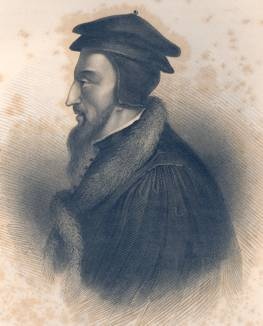
Calvin's 500th birthday was this year. There have been conferences and celebrations all over the world, and rightly so.

I'll steal wisdom from Ghandi here. Of Christianity, he said, "I like your Christ. I do not like your Christians; they are so unlike Christ."

I feel the same way about John Calvin. He was a faithful pastor who wanted to preach the Bible. Yet many people who want to go by his name are arrogant knuckleheads. He would've hated the title "protestant" and loved the title "reformer." He was way more Catholic than Presbyterians and Catholics are willing to admit. Timothy George correctly states that Calvin was "a theologian of both/and, not either/or: divine sovereignty and human responsibility, written Word and living Spirit, the Church invisible and the Church congregational, already and not yet."


George's full article can be read here. He discusses Calvinism as it relates to capitalism, Calvin and Servetus, and three reasons Calvin's ideas are getting traction again today.
Tuesday, March 3, 2009

THEOLOGY - SUFFERING = THEORY

This is from Calvin's "Epistle to the Reader" that prefaced his last edition of The Institutes. It is a fresh reminder that if upright doctrine is not tried, it is not complete. Forget not this fitting adage, my friends — true THEOLOGY and true DOXOLOGY always walk hand in hand.
As a clear proof of the diligence with which have I laboured to perform this service to the Church of God, I may be permitted to mention, that last winter, when I thought I was dying of quartan ague, the more the disorder increased, the less I spared myself, in order that I might leave this book behind me.

For, by the blessing of God, my most ardent desire has been to advance his kingdom and promote the public good — although I feel perfectly conscious, and take God and his angels to witness, that ever since I began to discharge the office of teacher in the Church, my only object has been to do good to the Church, by maintaining the pure doctrine of godliness, yet I believe there never was a man more assailed, stung, and torn by calumny [as well by the declared enemies of the truth of God, as by many worthless persons who have crept into his Church—as well by monks who have brought forth their frocks from their cloisters to spread infection wherever they come].

But the devil, with all his crew, is mistaken if he imagines that, by assailing me with vile falsehoods, he can either cool my zeal, or diminish my exertions. I trust that God, in his infinite goodness, will enable me to persevere with unruffled patience in the course of his holy vocation.

Farewell, kind reader. If you derive any benefit from my labours, aid me with your prayers to our heavenly Father.

Geneva, 1st August 1559.

"I profess to be one of those who, by profiting, write, and by writing profit." —Augustine

Tuesday, December 9, 2008

dominated by the word of God [calvin]

One month before he died at age 54, Calvin wrote his last will and testament. Notice how beautifully Bible-drenched and God-besotted he was.


In the name of God, I, John Calvin, servant of the Word of God in the church of Geneva, thank God that He has shown not only mercy toward me, His poor creature, but what is much more, that He has made me a partaker of His grace to serve Him, through my work. I confess to live and die in this faith which He has given me, inasmuch as I have no other hope or refuge than His predestination upon which my entire salvation is grounded. I embrace the grace which He has offered me in our Lord Jesus Christ and accept the merits of His suffering and dying, that through them all my sins are buried; and I humbly beg Him to wash me and cleanse me with the blood of our great Redeemer so that I, when I shall appear before His face, may bear His likeness. Moreover, I declare that I endeavored to teach His Word undefiled and to expound Holy Scripture faithfully, according to the measure of grace which He has given me.

Tuesday, May 13, 2008

CALViN and LUTHER ON BAPTiSM [for john paulling]

Calvin:
From these words, John 3.23, it may be inferred, that baptism was administered by John and Christ by plunging the whole body under water. Here we perceive how baptism was administered among the ancients; for they immersed the whole body in water.
Luther:
The term baptism is a Greek word. It may be rendered immersion, as when we plunge something in water, that it may be entirely covered with water. And though that custom is now abolished among the generality [for even children are not entirely immersed, but only have a little water poured on them] nevertheless, they ought to be completely immersed, and immediately drawn out. For the etymology of the word evidently requires it.

Monday, March 10, 2008

KNOWiNG GOD & iSAiAH 45.5-6

Isaiah begins with the heavens and the earth testifying to the fact the YHWH's people don't know Him [1.3]. This is not a simple "knowing" as in how you know that 2+2=4. This is an experiential knowing. This the "Adam knew Eve" kind of knowing from Gen 4.1 [KJV, from the Hebrew yada]. This theme of "knowing" can be traced throughout the whole of Isaiah.

When YHWH speaks in Isaiah 45.5-6, there is a beautiful structure that accents the significance of this knowing.


This does not merely show the importance of this intimate kind of knowledge, but this text proves, by its structure, that this knowing is rooted in YHWH's character and exclusivity. 

Many who write theology books begin with proving the existence of God, the authority of the Scriptures, or some other foundational building block. But our good, dead buddy John Calvin began his theological opus ["The Institutes of Christian Religion"] with a chapter on knowing God. I think there is a beautiful distinction there. He began with relationship.

John Frame and Esther Meek would agree with him. Calvin said, "They that know God and know themselves cannot be proud." May it be so with us also as we pursue the kind of knowing that Israel seemed to so often lack.

Monday, October 15, 2007

DAMNiNG DESPAiR

William Cowper thought he was not among the elect. This is apparent in his poetry, his depression, and even in some of his hymns. G. K. Chesterton saw it. In Orthodoxy, he claimed that Cowper was “damned by John Calvin.” Cowper was friends with John Newton [pastor and hymnist who wrote “Amazing Grace”] and lived with him for 12 years. Newton would write to William to encourage him in his fearful despair.

July 30, 1767 [excerpts]:

I can only advise you to resist to the utmost every dark and discouraging suggestion.

Though sin has abounded in us, grace has superabounded in him; though our enemies are many and mighty, Jesus is above them all; though He may hide himself from us at times, He has given us a warrant to trust him, even while we walk in darkness, He has promised to return, and gather us with everlasting mercies.

So, to renounce self, to live upon Jesus, to walk with God, to overcome the world, to trust the Lord when we cannot trace him, and to know that our duty and privilege consist in these things, may be readily or quickly learned; but, upon repeated trial, we find that saying and doing are two different things.

We please ourselves with agreeable prospects and proposals; but determination is with the Lord. We may rejoice that it is, He sees all things in their dependences and connexions, which we see not, and therefore he often thwarts our wishes for our good.

Let us strive and pray for a habitual resignation to his will; for He does all things well. It is never ill with us but when our hearts doubt or forget this plainest of truths.

Friday, August 3, 2007

the cross

Regarding our Lord Jesus’ work on the cross, Luther calls it the FONS SALUTIS… salvation’s Gospel spring that has been opened to refresh sinners.

Calvin calls it the CARDO SALUTIS… the hinge in which our salvation turns.

Monday, July 2, 2007

anthropological and psychological Calvinism

Calvin's discourses in THE INSTITUTES on man's will and man's nature are quite good. Not only does he draw extensively from the scriptures, but traces philosophy and theology through history to see what they have to say. He quotes from Augustine, Chrysostom, Plato, Cicero, Aristotle, Seneca, Lombard, Ambrose, Jerome, Origen, Bernard, Anselm, and Eucherius. He suggests that we are often "intoxicated with a false opinion of our own discernment." But here is my favorite....

"He who is most deeply abased and alarmed by the consciousness of his disgrace, nakednes
s, want, and misery has made the greatest progress in the knowledge of himself."

What a sobering and humbling truth.